
The Legendary Lake Whitefish
and the Apex Predator Lake Trout
June 22, 7:00 PM
Kress Pavilion, Egg Harbor, WI
The Door County Environmental Council presented “The Legendary Lake Whitefish and the Apex Predator Lake Trout” on June 22, 7:00 PM, at the Kress Pavilion at 7845 Church St. in Egg Harbor, WI.
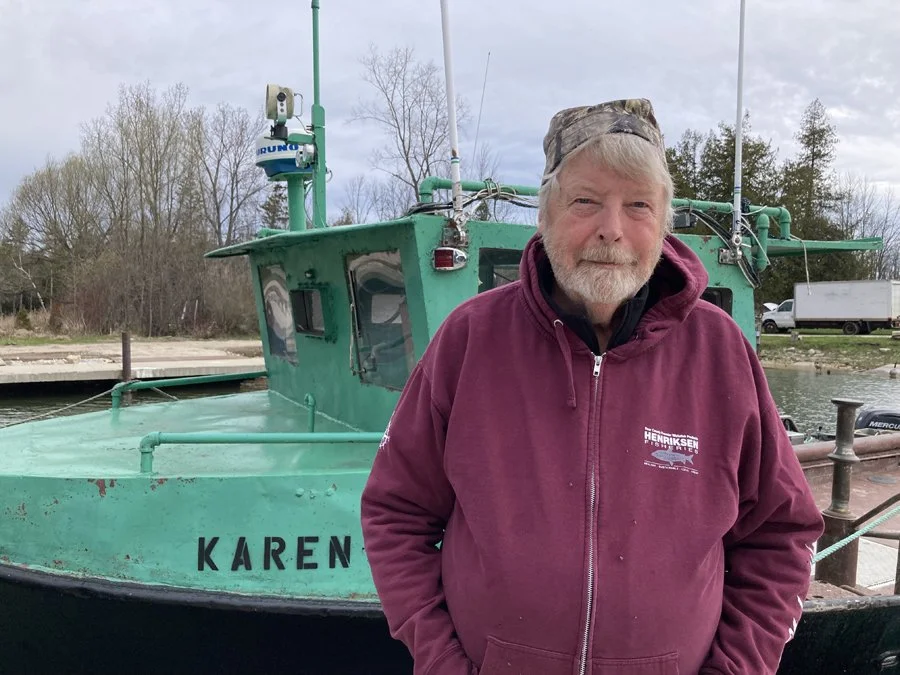
The speaker, Charlie Henriksen, owner and founder of Henriksen Fisheries in Door County, explained why whitefish are proliferating in Green Bay and declining in Lake Michigan and why lake trout are experiencing a resurgence.
Whitefish have experienced a population boom in the bay of Green Bay, while simultaneously declining in the main basin of Lake Michigan. This paradox is driven by different ecological conditions, as the nutrient-rich, shallower Green Bay provides food and better spawning habitats, whereas invasive mussels have caused a severe "nutrient desert" in the main Lake Michigan basin. Meanwhile, lake trout in Lake Michigan are experiencing a strong recovery, with healthy population abundances, increased wild reproduction, and successful management of invasive sea lampreys. While still heavily reliant on stocking, wild fish now make up a growing proportion of the population, particularly in the northern and mid-lake refuges.
Born and raised in Chicago, Charlie Henriksen came to Door County during a break from college to help his parents who bought an old hotel in Ellison Bay. He soon became fascinated with the work and expertise of local fishermen. His interest led to a career in commercial fishing and the establishment of Henriksen Fisheries and more recently, Henriksen’s Fish House.
Besides providing premier whitefish to over 30 businesses in Door County, Charlie, a legend himself, has been deeply committed to the preservation of the Lake Michigan fishing industry. He was president of the Wisconsin Commercial Fisheries Association for over 30 years, Chair of the Lake Michigan Commercial Fishing Board, and served on the Wisconsin Invasive Species Council, to name a few of the organizations he has been involved with.
Charlie has also worked with UW-Stevens Point, Wisconsin DNR, U.S. Fish and Wildlife Service, and Sea Grant in a variety of research projects in Green Bay and Lake Michigan. They included diet studies, sturgeon tagging, whitefish movement and abundance, and commercial catch composition and discard mortality studies. Currently, Charlie is working with UW-Milwaukee and UW-Green Bay on the range of hypoxic areas (dead zones) and early warning systems, especially in Green Bay.
Over the 50 plus years that Charlie has been a fisher, he has experienced constant challenges from changing political climates to climate changes. From the infiltration of zebra and quagga mussels, to expanding hypoxia in the bay of Green Bay, to the decline of winter ice coverage across the Great Lakes, the whitefish population has been challenged, but is now surviving and flourishing due to their ability to adapt to changing environments. Like the whitefish, Charlie states, “To succeed in the modern fishery, you need to be able to adapt, be open to new ideas, and have the wherewithal to try them. Managing the resource is a bit of a crapshoot because things do not go as planned, and Mother Nature is in charge. My longtime observation is that the only sure thing in our business is that things are gonna change.” (“Changing Waters” 2025 Peninsula Pulse Sustainability Issue.)
Thanks to Charlie’s dedication to the commercial fishing industry, he and his family are helping to preserve our Door County aquatic environment and feed a population of residents and visitors with one of the things that makes Door County famous.