Above and Beyond the Recycling Bin
How would your lifestyle change if you were responsible for keeping each piece of packaging you consume? The items we use and throw away on a daily basis will outlast us by hundreds to thousands of years. During their long lifespan, they slowly break down into microscopic particles leaching toxic chemicals in our waters, soils, and bodies. According to a 2017 study by Hoffman and Hittinger, “...half of the plastic pollution entering the Great Lakes—5,000 metric tons per year—goes into Lake Michigan—approximately the equivalent of 100 Olympic-sized pools full of plastic bottles dumped into the lake every year…”
Since the rapid adoption of plastic in the mid-20th century, the classic recycling model has continued to be pushed by the oil and gas industry as the solution to our growing amount of packaging waste. However, compared to infinite recyclable materials such as aluminum and glass, the degradation of recyclable plastics during the recycling process does not prevent their final landfill destination. While recycling can be an effective method of extending the lifespan of products, lasting change can only be achieved with the commitment to reduce the production and consumption of plastic and other harmful materials.
As consumers, we are responsible for remaining educated and engaged in recycling programs in order to keep our waste in circulation for as long as possible and out of landfills. This is not always easy. This article addresses some common misconceptions and questions about recycling in Door County and actions we can take to personally minimize the amount of waste sent to landfills. Additionally, it will discuss the Extended Producer Responsibility (EPR) legislation recently introduced in Wisconsin and its growing popularity as a method to shift the responsibility of packaging disposal to the producers.
The internal debate of determining if something can be recycled is a familiar experience. Commonly accepted materials include paper, metal, glass, and some types of plastic, although this can vary depending on the recycling service. Engaging in “wish-cycling”, such as trying to recycle plastic bags, styrofoam, materials contaminated with food and liquids, shredded paper, and scrap metal, can lead to sending more items to landfills than necessary. Safety is important too. Recycled materials are often sorted mechanically and by hand. It is incredibly important to properly dispose of fuel tanks, cords and wires, textiles, batteries, and sharp items such as needles to prevent accidents.
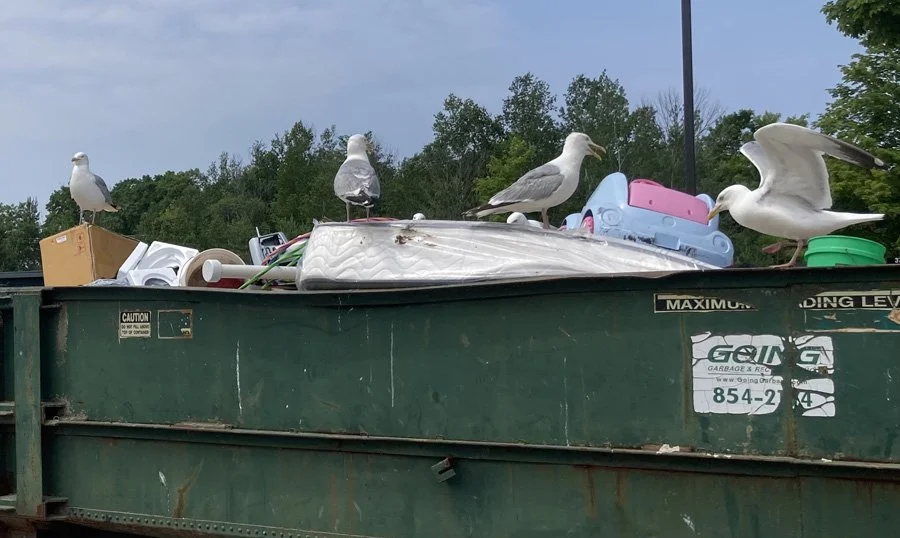
The last visible part of recycling occurs with the curbside collection of containers, naturally distancing us from the rest of the process and potentially raising questions. Representatives from GFL Environmental and Going Garbage, two of the largest waste management operations in Door County, shared that a large misconception occurs when customers in rural areas see their trash and recycling being collected in the same truck. Due to transportation costs, split-bodied trucks with separate sections for trash and recycling are used more often in non-urban areas, and do not mean recycling efforts are futile.
The landscape of recycling in the United States has changed dramatically since 2018, when China stopped accepting large quantities of our materials due to contamination concerns. While the U.S. continues to send a portion of our recyclable materials abroad, domestic infrastructure has been developing to try to meet the growing demand. An integral step in the recycling process occurs when recyclables are transferred to materials recovery facilities (MRFs), where they are sorted and prepared to be sold and turned into raw materials or new products. MRFs continue to improve with new sorting technology innovations and investments. However, according to Tri-County Recycling, a partnership between Brown, Outagamie, and Winnebago counties, an average of 20-25% of all materials transported to U.S. MRFs are still sent to landfills. Tri-County Recycling reports their MRF in Appleton, which receives materials from Going Garbage and other Northeast Wisconsin communities, has averaged closer to 10% in the past three years. This success demonstrates the value of recycling in Door County as a method to prevent certain materials from being sent to landfills.
Although recycling is an important part of our waste management system, actions to reduce the creation and use of single-use plastic materials are critical. While we can alter our consumption habits by shopping with packaging waste in mind, it is often not an option or not financially feasible. Adopting an Extended Producer Responsibility packaging law to address these difficulties is a growing trend for markets in the European Union, the United Kingdom, South Africa, and beyond. Seven U.S. states have adopted EPR laws so far, and both Wisconsin and New Hampshire have introduced EPR legislation in late 2025 and early 2026. Wisconsin has used EPR precedents from other states to propose AB 772. Introduced in December 2025, its goal is to incentivize producers to reduce total single-use packaging and the use of toxic substances, and increase the amount of packaging that can be reused, refilled, and recycled. The proposed program instates fees for the use of various packaging materials and distributes these producer payments to local governments and private companies to fund packaging reduction, refill, and reuse programs, transportation, and recycling networks. If this bill passes, all qualifying producers must register with this program before selling or distributing packaged products in Wisconsin, and non-compliant producers could face penalties up to $100,000 per day, per violation. AB 772’s ultimate objective is, “...70 percent of packaging being recycled within 12 years of the establishment of the program” (WI State Legislature, 2025). Please contact your state representative to express support for AB 772 and a future with less single-use and toxic materials polluting Wisconsin’s waters, soils, and residents.
If passed, this legislation has the potential to reduce the amount of packaging waste in Wisconsin. Individual actions can help these broader initiatives succeed. Alongside advocating for state and federal actions, we must call for and support local efforts to reduce single-use packaging and plastic waste. Following in the footsteps of the Village of Egg Harbor’s Green Tier Taskforce and promoting the local businesses limiting their waste independently or through the Climate Change Coalition of Door County’s Climate Forward Business Program is a great place to begin. As individuals, we can make an impact by purchasing items with less or no packaging, staying up to date on recycling guidelines, and educating ourselves and others on ways to protect Door County’s precious waters, soils, and coastlines.
By Kaleigh Kogler, Director
Sources:
https://stlcityrecycles.com/how-many-times-can-this-be-recycled/
https://www.npr.org/2020/03/31/822597631/plastic-wars-three-takeaways-from-the-fight-over-th e-future-of-plastics
https://www.rit.edu/news/researchers-study-plastic-pollution-great-lakes
https://goinggarbage.com/wp-content/uploads/2025/07/Tri-County-Recycling-Guide-2023-Officia l.pdf
https://sustainablepackaging.org/wp-content/uploads/2025/09/How-MRFs-Work_SPC.pdf
https://recyclemoretricounty.org/about-us/
https://docs.legis.wisconsin.gov/2025/proposals/ab772 https://sustainablepackaging.org/2026/01/22/packaging-policy-news/